
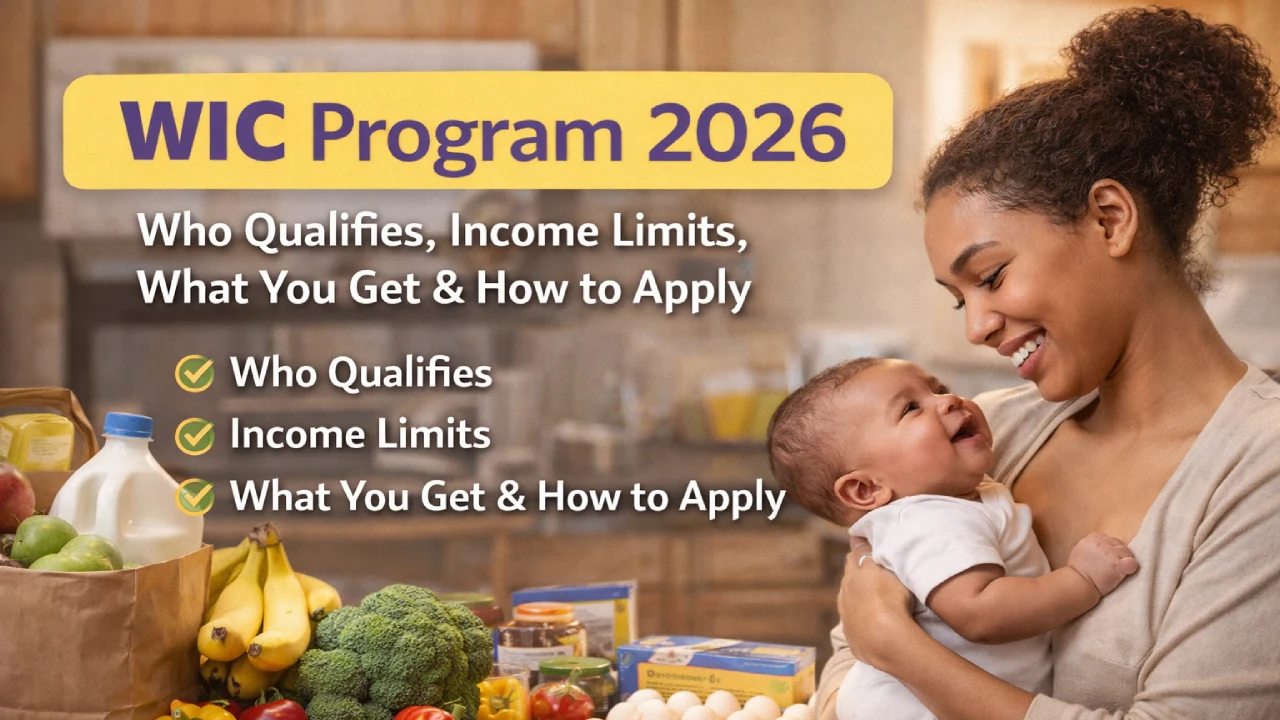
If you are pregnant, recently gave birth, breastfeeding, or have a child under the age of 5, the WIC program could provide you with free groceries, nutrition counseling, breastfeeding support, and healthcare referrals — every single month.
Millions of eligible families never apply for WIC, leaving hundreds of dollars in free food benefits unclaimed each year. This guide explains exactly who qualifies for WIC in 2026, what the income limits are, what benefits you will receive, and how to apply in any state.
Contents
- 1 WIC Program 2026: Key Facts
- 2 What Is WIC?
- 3 Who Qualifies for WIC in 2026?
- 4 2026 WIC Income Limits (July 2025 – June 2026)
- 5 Automatic Eligibility: Skip the Income Check
- 6 What Does WIC Provide in 2026?
- 7 How to Apply for WIC: Step-by-Step
- 8 Documents to Bring to Your WIC Appointment
- 9 Where Can You Use Your eWIC Card?
- 10 WIC Is Not Public Charge
- 11 Frequently Asked Questions
- 12 Final Thoughts
WIC Program 2026: Key Facts
What Is WIC?
WIC stands for the Special Supplemental Nutrition Program for Women, Infants, and Children. It is a federal nutrition program run by the U.S. Department of Agriculture (USDA) and administered by each state’s health department.
WIC is not just a food voucher program. It provides a full package of support including:
- Monthly food benefits loaded onto an eWIC card (works like a debit card)
- Cash Value Benefits (CVB) specifically for fresh and frozen fruits and vegetables
- Personalized nutrition counseling and education
- Breastfeeding support, education, and free breast pumps
- Referrals to healthcare, immunizations, social services, and other programs
- Health screenings for anemia, growth issues, and nutritional deficiencies
Who Qualifies for WIC in 2026?
WIC is available to specific categories of people — not all low-income families. You must fall into one of the following groups and meet the income requirement:
🏁 Pregnant Women
Women who are currently pregnant at any stage. The unborn baby counts as an additional household member when calculating income eligibility, which raises the income limit. WIC coverage during pregnancy typically continues through the end of pregnancy.
👶 Postpartum Women (Non-Breastfeeding)
Women who gave birth within the last 6 months and are not breastfeeding. WIC provides nutritional support during the postpartum recovery period.
🍼 Breastfeeding Mothers
Women who are breastfeeding their infant up to the baby’s first birthday. Breastfeeding mothers receive a more generous food package than non-breastfeeding postpartum women, including additional calories and nutrients.
👶 Infants (Under 12 Months)
Babies under 1 year old. Infants whose mothers are not breastfeeding receive WIC-approved infant formula. Breastfed infants receive solid food support. Infants whose mothers participate in WIC automatically qualify.
👦 Children (Ages 1 to 4)
Children who are at least 1 year old and have not yet turned 5. Children receive a food package tailored to support healthy growth and development. A nutritional risk determination is required, but most young children easily meet this standard.
2026 WIC Income Limits (July 2025 – June 2026)
To qualify for WIC based on income, your total gross household income (before taxes) must be at or below 185% of the federal poverty level. The table below shows the monthly and annual income limits for the 48 contiguous states, Washington D.C., Guam, and U.S. territories:
| Household Size | Max Monthly Gross Income | Max Annual Gross Income |
|---|---|---|
| 1 person | $2,413 | $28,953 |
| 2 people | $3,267 | $39,200 |
| 3 people | $4,120 | $49,438 |
| 4 people | $4,974 | $59,675 |
| 5 people | $5,828 | $69,913 |
| 6 people | $6,681 | $80,150 |
| 7 people | $7,535 | $90,388 |
| 8 people | $8,388 | $100,625 |
| Each additional person | +$854 | +$10,238 |
Automatic Eligibility: Skip the Income Check
If you or your child already participates in any of the following programs, you are automatically income-eligible for WIC without needing to prove your income separately. This is called adjunctive eligibility:
- Medicaid (any category)
- SNAP (food stamps / CalFresh / etc.)
- TANF (Temporary Assistance for Needy Families)
- Certain other state-specific assistance programs
What Does WIC Provide in 2026?
WIC benefits are loaded monthly onto an eWIC card — a state-issued card that works like a debit card at most grocery stores, Walmart, Target, and some farmers markets. Benefits vary by participant category:
🎶 Pregnant Women
- Milk or soy milk
- Eggs
- Whole grain bread, cereal, tortillas
- Juice (limited)
- Legumes or peanut butter
- Canned fish (tuna or salmon)
- Fruits & vegetable Cash Value Benefit (CVB)
🎤 Breastfeeding Mothers
- Larger food package than non-BF moms
- Milk, eggs, cheese
- Whole grains, juice
- Canned fish, legumes, peanut butter
- Higher CVB for fruits & vegetables
- Free breast pump
- Breastfeeding support & counseling
👶 Infants (0–5 months, formula-fed)
- WIC-approved infant formula (full supply)
- Iron-fortified infant cereal
- Infant fruits and vegetables (jarred)
👶 Infants (6–11 months, breastfed)
- Baby food — meats, fruits, vegetables
- Iron-fortified infant cereal
- Infant formula (partial)
👦 Children (Age 1–4)
- Milk (whole milk for ages 1–2)
- Eggs
- Whole grain bread, cereal, pasta
- Juice (limited)
- Legumes or peanut butter
- CVB for fruits & vegetables
- Tofu or soy milk (if needed)
🌿 All Participants — Cash Value Benefit (CVB)
- Monthly allowance on eWIC card
- Use for fresh, frozen, or canned fruits & vegetables
- Now includes fresh herbs (new in 2026)
- Can be used at stores, farmers markets, and some online retailers
How to Apply for WIC: Step-by-Step
Applying for WIC is free, takes about 30–60 minutes, and must be done in person at a WIC clinic or office for your first appointment. Here is exactly what to do:
- Find your nearest WIC office. Go to wiclocator.fns.usda.gov or call 1-800-942-3678 to find your local WIC agency. WIC offices are usually located in county health departments, community health clinics, or hospitals.
- Call to schedule an appointment. Most WIC offices require an appointment. Some offices accept walk-ins. Ask if telephone or video appointments are available — many states now allow this for follow-up visits in 2026.
- Gather your documents (see list below) and bring them to your appointment.
- Attend your appointment. WIC staff will verify your identity, residency, income, and categorical eligibility. A health professional will conduct a brief, free nutritional screening — including a height and weight check and a finger-prick blood test for iron levels for children. This takes about 15–30 minutes.
- Receive your eWIC card and benefits. If approved, your monthly food benefits will be loaded onto your eWIC card immediately or within a few days. You can start using them right away at participating stores.
- Attend follow-up appointments. WIC requires periodic check-in appointments — typically every 3 to 6 months — to renew your benefits. Many states now allow these by phone or video call.
Documents to Bring to Your WIC Appointment
- Proof of identity — driver’s license, state ID, passport, or birth certificate for children
- Proof of address (residency) — utility bill, lease agreement, or piece of official mail with your name and address
- Proof of income — recent pay stubs, tax returns, or employer letter. Not required if you already have Medicaid, SNAP, or TANF.
- Medicaid, SNAP, or TANF card or approval letter — if you receive any of these benefits, bring proof to skip the income verification
- Proof of pregnancy — a letter or note from your doctor, midwife, or clinic confirming your due date
- Child’s immunization records — if applying for a child (not always required but helpful)
Where Can You Use Your eWIC Card?
Your eWIC card works at most major grocery stores and retailers that are authorized WIC vendors, including:
- Walmart, Target, and Kroger stores nationwide
- Safeway, Publix, H-E-B, Aldi, and most regional supermarkets
- Many independent grocery stores and ethnic food markets
- Farmers markets that accept WIC (look for the WIC sign)
- Some online retailers including Amazon Fresh and Walmart Grocery (state-dependent)
WIC Is Not Public Charge
As of 2026, WIC participation is not considered in the public charge test used by the U.S. government when evaluating immigration applications for permanent residency. This has been a consistent federal policy and is confirmed on all official WIC materials. Non-citizen families who are otherwise eligible should not be afraid to apply.
Frequently Asked Questions
No. WIC is specifically excluded from the public charge test. Receiving WIC will not affect a green card application or any other immigration benefit. This applies to both the applicant and their family members.
Yes. Any parent, legal guardian, or caretaker can apply for WIC on behalf of an eligible infant or child. The child must be present at the first appointment for the nutritional screening.
Yes. WIC is based on gross income, not employment status. Many working families qualify because the income limit (185% of the federal poverty level) is higher than many people expect. A family of four can earn up to $4,974 per month and still qualify.
Yes — and you should apply as early as possible. WIC benefits during pregnancy help support healthy fetal development and reduce the risk of complications. Apply as soon as you know you are pregnant, even in the first trimester.
Yes. SNAP and WIC are completely separate programs and you can receive both at the same time. In fact, receiving SNAP makes you automatically income-eligible for WIC — no additional income verification is needed.
Pregnant women receive WIC through the end of pregnancy. Breastfeeding mothers can receive WIC until their baby turns 1 year old. Non-breastfeeding postpartum women can receive WIC for 6 months after delivery. Children can receive WIC from birth until their 5th birthday.
Yes. WIC agencies are required by federal law to provide free language assistance to people with limited English proficiency. Interpreter services, translated materials, and bilingual staff are available at most WIC offices across the country.
No. WIC is available to non-citizens, including undocumented immigrants, as long as they meet the income and categorical requirements. There is no citizenship or immigration status requirement for WIC eligibility.
Final Thoughts
WIC is one of the most under-used government nutrition programs in the United States. Millions of families who fully qualify — including many working families — never apply simply because they do not know about it or assume their income is too high.
In 2026, WIC provides more foods than ever before, including expanded fruit and vegetable benefits, new protein options, and greater flexibility in food choices. If you are pregnant, breastfeeding, have an infant, or have a child under 5, applying for WIC costs nothing and takes less than an hour. The benefits you receive can easily be worth $100 to $400 or more per month in free groceries — do not leave that on the table.
Ready to Apply for WIC?
Find your nearest WIC office and schedule a free appointment today. No cost to apply, no cost to participate.
Find a WIC Office Near You → Check If You Qualify →