
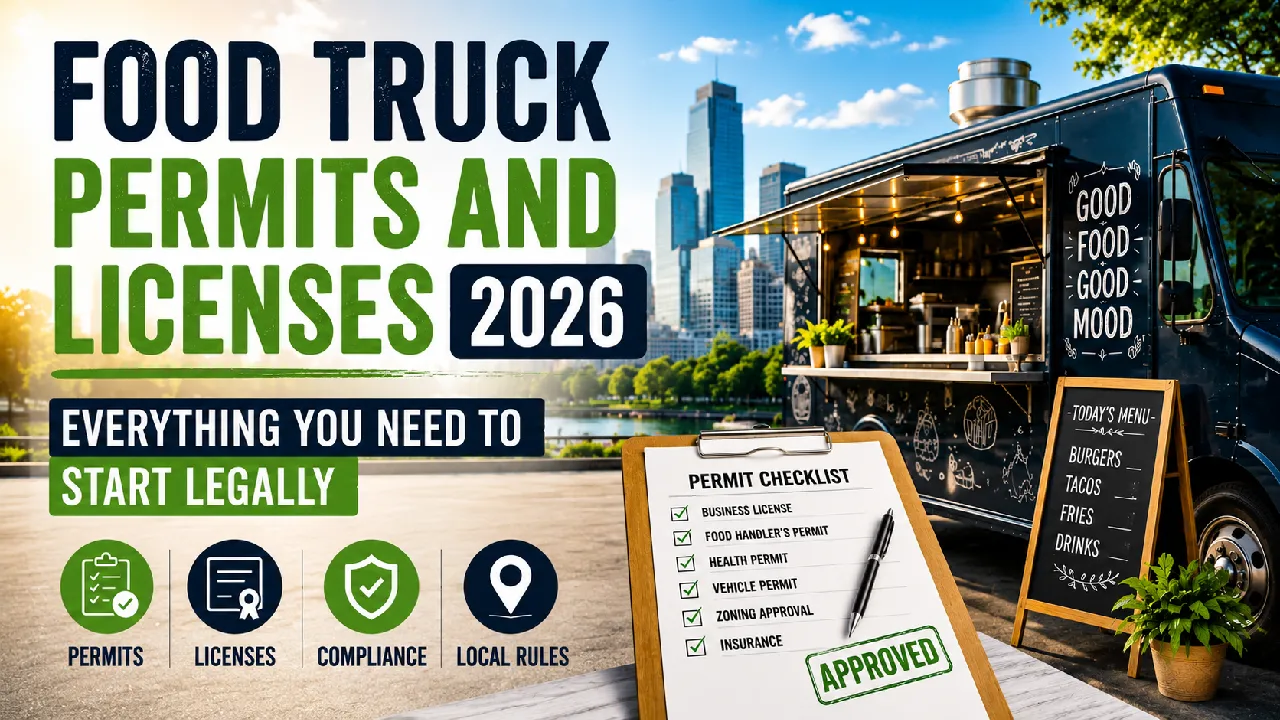
Starting a food truck is one of the most exciting ways to launch a food business — lower startup costs than a restaurant, the freedom to move between locations, and a direct connection with your customers on the street. But before you serve your first taco, burger, or dessert, you need to navigate a web of permits and licenses that vary by city, county, and state.
This complete 2026 guide covers every permit and license most food trucks need, how much they cost, how to apply for them, and important new changes that took effect in 2026 — including a brand-new Texas statewide food truck permit law.
Food Truck Industry 2026: Key Numbers
The 13 Permits and Licenses Most Food Trucks Need in 2026
🏠 1. Business License
Required in most citiesA business license — sometimes called a vendor license or general business operating permit — is the foundational document that recognizes your food truck as a legitimate business in your city, county, or state. Without it, every other permit you obtain may be void.
Cost: $50 to $500 depending on location, with some cities charging annual renewal fees
Where to apply: Your city or county clerk’s office, or your state’s business registration portal
Note: Some cities limit the number of mobile food vendor licenses issued and use a lottery system — apply as early as possible.
🎯 2. Employer Identification Number (EIN)
RequiredAn EIN is a free federal tax ID number from the IRS that you need to open a business bank account, hire employees, and apply for most business licenses and permits. Even solo operators benefit from having one to keep personal and business finances separate.
Cost: Free
Where to apply: irs.gov/ein — instant approval online, takes about 10 minutes
🍵 3. Health Department Permit (Mobile Food Facility Permit)
Required everywhereThis is the most critical permit for any food truck. It is issued by your local or county health department after your truck passes a health inspection that verifies your food preparation, storage, sanitation, and equipment meet food safety codes.
Cost: $100 to $1,000+ depending on county and food risk level — higher-risk operations (raw meat, dairy, eggs) pay more than lower-risk ones (prepackaged foods, beverages)
Where to apply: Your city or county health department
What they inspect: Food storage temperatures, handwashing facilities, surface cleanliness, equipment calibration, proper labeling, and waste disposal systems
Tip: Your truck must pass inspection before this permit is issued. Prepare using your health department’s inspection checklist — most publish it online.
🔥 4. Fire Safety / Fire Department Permit
Required if you cook on the truckIf your food truck uses cooking equipment, propane, or open flames, the fire department must inspect your truck and issue a fire safety permit. Approximately 80% of food trucks use propane, making this permit essential for most operators.
What fire inspectors check:
- Proper installation of cooking equipment and gas lines
- Working fire suppression system (hood/ansul system)
- Electrical wiring and connections
- Fire extinguishers — correct type, properly mounted, and current inspection tag
- Propane tank storage and venting
Cost: Typically $100–$300 per year for the permit, plus the cost of any required equipment upgrades
Where to apply: Your local fire department or fire marshal’s office
📋 5. Seller’s Permit (Sales Tax Permit)
Required in most statesA seller’s permit — also called a sales and use permit — authorizes your food truck to collect sales tax on taxable sales. In most states, prepared food is taxable even if raw grocery items are not. Without this permit, you are illegally collecting or failing to collect sales tax.
Cost: Free in most states (though some require a security deposit)
Where to apply: Your state’s department of taxation or revenue — most allow online registration
Note: A seller’s permit also allows you to purchase wholesale ingredients without paying sales tax at the time of purchase — saving money on food costs.
🚬 6. Food Handler’s Permit / Food Handler Card
Required for all food workersMost states and counties require every person who prepares, handles, or serves food on a food truck to hold a valid food handler’s permit or card. This is obtained by completing an approved food safety course and passing a short exam.
Cost: $10–$30 per person (California caps the cost at $15 by state law)
Where to get it: Through programs approved by your local health department — most commonly ServSafe Food Handler or Learn2Serve Food Handler Card
Validity: Typically 2–3 years depending on the state, then must be renewed
🎖 7. Food Safety Manager Certification
Required in many jurisdictionsSeparate from the basic food handler card, many health departments require at least one person on the food truck to hold a Food Safety Manager Certification — a more comprehensive credential earned by passing a proctored exam. This person must be on the truck during all operating hours in many jurisdictions.
Cost: $100–$200 for the exam (ServSafe Manager or equivalent)
Where to apply: ServSafe (servsafe.com), Learn2Serve, or another ANSI-accredited program approved by your health department
🏭 8. Commissary Agreement
Required in many citiesA commissary is a licensed commercial kitchen facility where food trucks prep, store, and clean their equipment when not operating on the road. Many cities and counties require food trucks to have a commissary agreement before issuing a health permit — and require daily or regular check-ins.
Cost: $400–$1,500 per month depending on location and usage level
What a commissary provides: Certified prep space, water and waste disposal, storage for dry goods and refrigerated items, commercial dishwashing facilities, and sometimes shared cooking equipment
How to find one: Search “[your city] food truck commissary” or ask your local health department for a list of approved commissaries
🚌 9. Vehicle Registration and Commercial Vehicle Permit
RequiredYour food truck must be registered as a commercial vehicle with your state’s DMV. Depending on the weight and size of your truck, you may also need a Commercial Driver’s License (CDL) to operate it legally on public roads.
Vehicle registration cost: Varies by state — typically $100–$400 per year
CDL requirement: Generally required if your truck has a Gross Vehicle Weight Rating (GVWR) over 26,001 pounds. Most standard food trucks fall below this threshold, but verify with your state DMV.
Also required: Commercial auto insurance covering both the vehicle and the business operations inside it
🏙️ 10. Parking and Zoning Permit
Required in most citiesWhere you can legally park and operate your food truck is heavily regulated in most cities. Zoning laws determine which areas allow mobile food vending, how long you can park in one spot, minimum distance requirements from brick-and-mortar restaurants and schools, and whether you need a special parking permit for specific locations.
Cost: Free to $400+ depending on location and duration
Types of parking situations:
- Public street vending: Requires a specific street vending permit from your city — highly competitive in major cities
- Private property: Requires written permission from the property owner and often a zoning permit from the city
- Events and festivals: Separate event permits required from event organizers and sometimes from the city
- Food truck parks: Usually the simplest option — the park handles most permitting
🔧 11. Building or Equipment Permit
May be requiredIf you are converting a vehicle into a food truck or installing commercial cooking equipment, some jurisdictions require a building or equipment installation permit before the health department will inspect. This is especially common if you are installing a hood suppression system, gas lines, or electrical upgrades.
Cost: $50–$200 per permit, depending on the jurisdiction
🌇 12. Special Event Permit
Required for festivals and eventsOperating at fairs, festivals, farmers markets, or private events often requires a separate temporary event permit in addition to your regular operating permits. Event organizers may also require proof of insurance and a copy of all your existing permits before allowing you to participate.
Cost: $25–$200 per event, varies widely by city and event type
🍼 13. Liquor License (If Serving Alcohol)
Optional — for alcohol onlyMost states do not allow food trucks to hold a standard full liquor license. However, some states allow food trucks to obtain temporary event liquor licenses for specific festivals or private events. If serving alcohol is part of your concept, research your state’s specific rules carefully — violations can result in criminal charges.
Cost: $105–$5,000+ depending on state and license type
Tip: Most food truck experts recommend keeping alcohol off the menu entirely to simplify licensing and compliance.
State-by-State Spotlight: Rules in Major States (2026)
🏦 Texas — NEW in 2026
- HB 2844 effective July 1, 2026
- Single statewide permit replaces city-by-city permits
- Administered by DSHS statewide
- Saves most operators thousands per year
- Still need EIN, seller’s permit, vehicle registration
🌴 California
- No statewide food truck license
- County health department issues all permits
- Commissary required in most counties
- Seller’s permit from CDTFA (free)
- Food handler card max $15 (SB602)
- CalGOLD.ca.gov for permit checklist
🏝️ Florida
- Business license varies by county
- Mobile Food Facility permit from county health
- Seller’s permit required (free via SBA portal)
- Liquor license: $1,820–$5,000 if applicable
- ServSafe food handler required
🌈 New York / NYC
- NYC has one of the most complex systems
- Mobile Food Vendor Permit from NYC DOHMH
- Permit lottery — limited licenses issued
- Average 6–20 weeks to get fully permitted
- Total startup permit cost: $1,200–$5,000+
⛏ Colorado / Denver
- Denver requires separate city permit from state
- 2026 reciprocity agreement begins (state + Denver)
- Denver Fire Dept. annual propane permit: $200
- Startup costs: $440–$900 initial, $350–$450/year
- HACCP plan required for plan review
🌱 Illinois
- Chicago has strict mobile vendor regulations
- Chicago Food Truck license from BACP
- Must stay 200 ft from brick-and-mortar restaurants
- GPS tracking required on Chicago trucks
- City health inspection required annually
Complete Food Truck Permit Checklist and Cost Summary
| Permit / License | Typical Cost | Where to Apply | Required? |
|---|---|---|---|
| Business License | $50–$500/year | City/County Clerk | Most cities |
| EIN (Federal Tax ID) | Free | irs.gov/ein | Yes |
| Health Department Permit | $100–$1,000+ | County Health Dept. | Yes — everywhere |
| Fire Safety Permit | $100–$300/year | Local Fire Dept. | Yes — if you cook |
| Seller’s Permit (Sales Tax) | Free | State Tax Authority | Most states |
| Food Handler’s Card | $10–$30 per person | Approved programs (ServSafe) | Most states |
| Food Safety Manager Cert. | $100–$200 | ServSafe / ANSI programs | Many jurisdictions |
| Commissary Agreement | $400–$1,500/month | Licensed commissary kitchens | Many cities |
| Vehicle Registration | $100–$400/year | State DMV | Yes |
| Parking/Zoning Permit | Free–$400 | City transportation/zoning dept. | Most cities |
| Special Event Permit | $25–$200 per event | City events office | For events only |
| Commercial Auto Insurance | $2,000–$4,000/year | Insurance provider | Yes |
| General Liability Insurance | $500–$1,500/year | Insurance provider | Strongly recommended |
Step-by-Step: How to Get Your Food Truck Permits in the Right Order
Applying for permits in the wrong order is one of the most common and costly mistakes new food truck owners make — some permits require others to be in place first. Follow this sequence:
- Form your business entity and get your EIN. Register as an LLC or corporation with your state’s Secretary of State. Then get your free EIN from the IRS at irs.gov/ein. You need both before applying for any other permits.
- Register for your seller’s permit / sales tax permit. Do this through your state’s tax authority. In most states this is free and can be done online in minutes. You need this before your health permit in many jurisdictions.
- Find and sign an agreement with a licensed commissary. Many health departments require proof of a commissary agreement before they will review your health permit application. Find your commissary first.
- Apply for your city or county business license. Contact your city or county clerk with your EIN and business formation documents. This is often required before health and fire inspections can be scheduled.
- Apply for your health department permit and schedule your health inspection. Submit your application to the local health department along with your commissary agreement, menu, and food preparation plans. Once approved, schedule your on-site inspection.
- Schedule your fire department inspection. Contact your local fire marshal to schedule the fire safety inspection of your truck. Make sure your suppression system, extinguishers, and gas lines are installed and tested before the inspector arrives.
- Get all food handler cards and manager certifications. Every person working on the truck should complete their food handler training before your health inspection, as inspectors often ask to see cards.
- Register your vehicle and get commercial insurance. Complete your DMV commercial vehicle registration and secure commercial auto and general liability insurance. Most permit offices require proof of insurance.
- Apply for parking and zoning permits for your locations. Once all other permits are in place, apply for the specific locations where you plan to operate — street vending spots, private lots, or food truck parks.
- Keep copies of every permit on the truck at all times. Most jurisdictions require you to display your health permit and have all other permits available for inspection on the vehicle. Create a permit binder and keep it in the truck.
How to Find Your Specific Local Requirements
Since food truck permitting is primarily local, your single most important step is contacting the right agencies for your city and county. Here is how to find exactly what you need:
- Your city or county health department website — search “[your city] mobile food facility permit” for the application, inspection checklist, and fees
- Your city clerk or business licensing office — for the general business license and any mobile vendor-specific permits
- Your state’s small business portal — most states have a business wizard that generates a permit checklist based on your business type and location
- The U.S. Small Business Administration — sba.gov has a license and permit search tool for every state
- Your local food truck association — city-level food truck associations often have current, practical guides to local permitting that go beyond what official websites explain
Frequently Asked Questions
Plan for 4 to 12 weeks from start to fully permitted, depending on your city. Smaller cities and rural areas are often faster. Major cities like Chicago, New York, and Los Angeles have the longest timelines — sometimes 3 to 6 months — due to high application volumes and more complex requirements. Start the process at least 3 months before your planned launch date.
Permit costs alone (excluding the truck, equipment, and food) typically range from $500 to $3,000 for the first year in most mid-size cities. In major cities like New York or Los Angeles, the cost can exceed $5,000. The U.S. Chamber of Commerce Food Truck Index puts the average first-year permit and compliance cost at $28,276 when all indirect costs (insurance, commissary, compliance) are included.
It depends on the size and weight of your truck. Most standard food trucks have a GVWR under 26,000 pounds, which means a regular driver’s license is sufficient in most states. Larger custom-built trucks or converted buses may exceed this threshold and require a CDL. Check your specific vehicle’s GVWR with your state DMV to confirm.
In many — but not all — cities, yes. Commissary requirements vary widely. Some jurisdictions require daily check-ins at a licensed commissary for cleaning, waste disposal, and restocking. Others require commissary use only for food prep. A few cities have no commissary requirement at all. Check with your county health department to find out what applies in your area.
Historically, no — most food trucks needed a separate permit from every city they operated in. This is starting to change. Texas’s new HB 2844 (effective July 1, 2026) creates a single statewide permit for the first time. Colorado is implementing a similar reciprocity agreement in 2026. Most other states still require city-by-city or county-by-county permits, so check your state’s current rules.
At minimum, you need commercial auto insurance (covering the vehicle while driving) and general liability insurance (covering incidents that happen while operating). Many venues, event organizers, and cities require proof of at least $1 million in general liability coverage before they allow you to operate. Food-specific product liability coverage is also strongly recommended. Expect to pay $2,500–$5,500 per year for a comprehensive food truck insurance package.
Consequences range from a warning and fine on a first offense to immediate shutdown, equipment seizure, and criminal charges for repeat violations. Fines typically run $500 to $1,000 per violation per day. In cities with strict enforcement — like Chicago and New York — health department and police inspections of food trucks are regular and systematic. It is never worth operating without proper permits.
Final Thoughts
Starting a food truck legally requires patience, research, and a systematic approach to permits — but it is entirely manageable if you follow the right sequence, start early, and make direct contact with your local health department and city clerk from day one.
The permitting landscape is actively changing in 2026, with Texas leading the way on statewide simplification and other states following. If you are planning to operate across multiple cities or states, stay current with regulatory changes in your target markets — the rules that applied two years ago may already be outdated.
Ready to Get Your Food Truck Permitted?
Start with your county health department and city clerk. Use the SBA license tool to find your state’s requirements.
SBA License & Permit Search → Get Your Free EIN →